Coarse Grinding
Step 1: Coarse Grinding
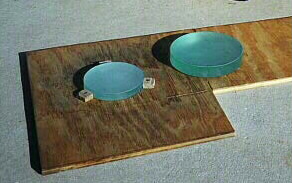
During coarse grinding you will work very hard! If you don't have a 55 gal drum filled with ballast your work will move all over! This time I opted for working on my hands and knees. That's really hard on the back but it did work. Here is the grinding board in the driveway. You go through the grit quickly and it can be messy, working outside was a good idea!
Step 2: Coarse Grinding
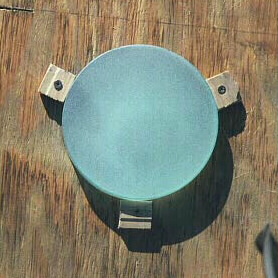
Holding the work in position is very important. Here I have 3 small blocks of wood (old molding) with a hole drilled through them and a wood screw going into the plywood base. The blocks should grip the mirror tight enough so that it can not be moved without loosening one of the screws.
Step 3: Hogging Tool
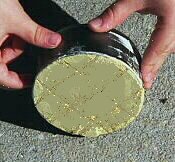
Hogging the blank is the hardest work you will see. The grit seems to vanish and the muscles will ache. A Dog Food can fits in the hand well and the steel rim can take the abuse. The dental stone is in the can to provide support to the can so you don't crush it under your weight.
Step 4: Coarse Grinding
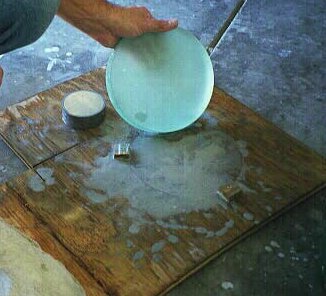
Here we are grinding away with SiC #80. The grit breaks down quickly but also cuts the glass too! This stage is to get the center of the mirror to about the right depth.
Step 5: Check Depth
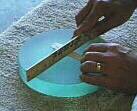
Keep grinding until the center is the right depth. Here I am using a ruler as straight edge and strips of paper as a feeler gauge. As an example the Sagitta for a 6" F/8 is 0.047" and 8" F/6 is 0.083" and that equates to 11 and 19 strips of 20 lb paper. Don't take my word on this, measure a whole bunch of strips for yourself. When the paper is very tight and can't be pulled out easily you are done! Next you need to make a tile tool and do a Coarse Sharpie Test. To compute the Sagitta use the following formula: Sag = (R*R) / (FL*4) R is the Radius of the Mirror and FL is the desired Focal Length